

Tyre pyrolysis as a method of disposal

Tire disposal is one of the most pressing issues, given the number of car owners and the fact that millions of tires are discarded annually. According to the Unified State Register of Vehicles, at the beginning of 2024, 13.16 million vehicles were registered in Ukraine, of which 9.8 million are passenger cars. Taking into account two sets of tires and a spare wheel, each passenger car uses an average of 9 tires - this is about 88 million units just for the passenger fleet, and over 110 million in total across the country's entire vehicle fleet. Stockpiling end-of-life tires in landfills or dumps poses a threat to the environment, as they contain various toxic and hazardous substances that pollute water, soil, and air. Therefore, car tires are sent for recycling, which allows them to be disposed of technologically, safely, and beneficially. One of the most effective disposal methods is tire pyrolysis. The technology is not new; it has been used all over the world for several decades.
What is tire pyrolysis and what are the features of the technology?
Pyrolysis is the process of decomposing a material into its individual components by heating it without access to oxygen. To put it simply, pyrolysis is the process of breaking down rubber under the influence of high temperatures. It should not be confused with combustion! Unlike combustion, pyrolysis is carried out without access to oxygen. That is, the combustion process is physically impossible, and there is no fire. However, the technology still involves exposing the materials to high temperatures – 400-800 degrees Celsius. The entire process takes place in sealed chambers, so there is no emission of soot, smoke, or toxic substances.
Today, this method is a priority when it comes to recycling car tires. It is also used by the environmental waste recycling center.
Features of the tire pyrolysis process
Tire pyrolysis is performed in closed, sealed units where end-of-life materials are placed and high temperatures are applied. The entire process is divided into stages:
- Preparation. At this stage, the tires are cleaned of contaminants and then shredded.
- Loading. The prepared material is loaded into the pyrolysis unit's reactor.
- Heating. At this stage, a high temperature is applied, which triggers the process of material molecule destruction.
- Condensation. During the pyrolysis process, gases are formed, which are passed through a cooling system and then condensed into a liquid.
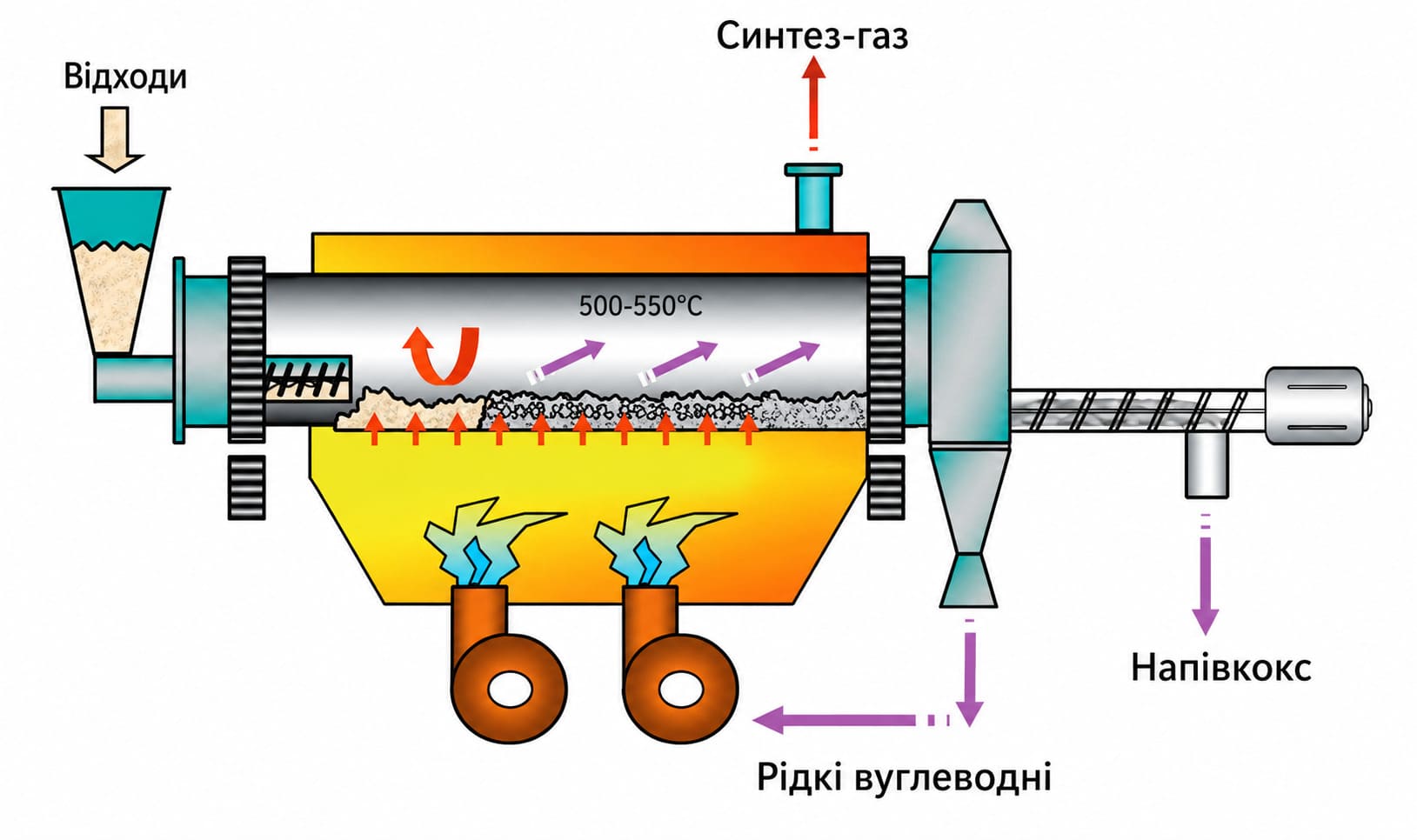
Since the entire process involves thermal exposure, a logical question arises: at what temperature does tire pyrolysis occur? The process starts at 350-450 degrees Celsius. To achieve complete destruction, the temperature is raised higher, up to 500-600 degrees. At such heating, the pyrolysis process of car tires occurs most efficiently.
Design features of the pyrolysis chamber
A pyrolysis unit is a modular structure consisting of several components:
- a sorting conveyor belt;
- a loading unit;
- a retort — a sealed chamber where shredded tires undergo thermal decomposition without access to oxygen;
- a heating chamber. It consists of two compartments – the main raw material decomposition process takes place in the lower one, and the used fuel is "afterburned" in the upper one, which prevents its release into the environment;
- a heat exchanger – a complex system of tubes of different diameters that cools the pyrolysis gas to separate it into different fractions: steam, water, and gas;
- an unloading module.
The design also includes auxiliary equipment. This includes a scrubber – a unit where the pyrolysis gas is cooled; a separator – where the moisture content of the pyrolysis gas is reduced; a condenser – which converts the pyrolytic gas into a liquid; and a filter system to clean it from the precipitate of combustion products.
Pros and cons of the technology
Rubber pyrolysis is widely used as a method for tire disposal. This is due to the practicality of the technology. Among its advantages are:
- Environmental friendliness. Pyrolysis units are sealed, so there is no emission of harmful substances into the atmosphere.
- The ash after pyrolysis does not contain aggressive toxins, which allows these residues to be buried in the soil or even used as fuel.
- The pyrolysis process is waste-free and energy-autonomous.
- Pyrolysis units can be used as an additional source of electricity for the population or an industrial facility.
- Liquidity. The products obtained as a result of recycling, such as pyrolysis oil, are in demand and have a high value.
It is also worth noting the profitability and economic benefits. During the pyrolysis process, 4 products are formed that can be reused:
- pyrolysis oil – up to 45% of the total mass. In terms of characteristics, it is similar to fuel oil and is used as fuel or as a raw material for producing gasoline and diesel;
- pyrolysis carbon black. This is the solid residue used in the manufacture of new car tires, paints, conveyor belts, or as a sorbent;
- steel cord – it is collected and sent for melting;
- pyrolysis gas – it is used by the unit to maintain the destruction temperature, which gives the pyrolysis method high energy efficiency.
In addition, car tire disposal through pyrolysis helps solve the problem of landfills, which are toxic and hazardous to the environment (tires are assigned hazard class 4).
Despite the significant advantages, the technology also has its drawbacks. Among them are:
- Equipment cost. Pyrolysis units are expensive, so their purchase and commissioning require significant investment.
- Safety requirements for the work process. Working with combustible gases and high temperatures requires strict adherence to technological regulations.
In general, despite the complexity, tire pyrolysis remains the most popular technology for recycling end-of-life tires. It allows for the safe disposal of tires and ensures high profitability.


